
There doesn’t have to be a crisis for a couple to feel that something in their relationship has changed.
There may have been no affair, no betrayal and no major event that either person can point to and say, “That’s when things went wrong.”
In fact, many parts of the relationship may be working very well.
Children are loved. Work gets done. Bills are paid. Weekends are organised. Decisions are made together. There may still be laughter, holidays, nights out and a genuine sense that you have built a good life together.
But it is still possible to look at that life and think: I love what we have built, but I miss something about us.
That doesn’t necessarily mean the relationship is in trouble. Sometimes it means that, while a couple has become very good at managing life together, there is less space for simply being together.
When practical life takes over:
Think about your conversations with your partner over the last few days.
How many were about something that needed to be organised?
Who’s doing the school run? What time are you home? What do we need from the shops? Has that bill been paid? What are we doing this weekend?
These conversations matter. A shared life depends on them.
The difficulty is not that couples have practical conversations. It is when practical conversations gradually become most of the conversations they have.
There can be less time for curiosity. Less time for talking without needing to reach a decision. Less opportunity to discover what your partner has been thinking about, to laugh together, to disagree about something unimportant, or simply to enjoy each other’s company.
Physical affection and intimacy can change too. This does not automatically mean that love or attraction has disappeared. Sometimes the relationship is simply carrying so many other responsibilities that there is less energy left for this part of being a couple.
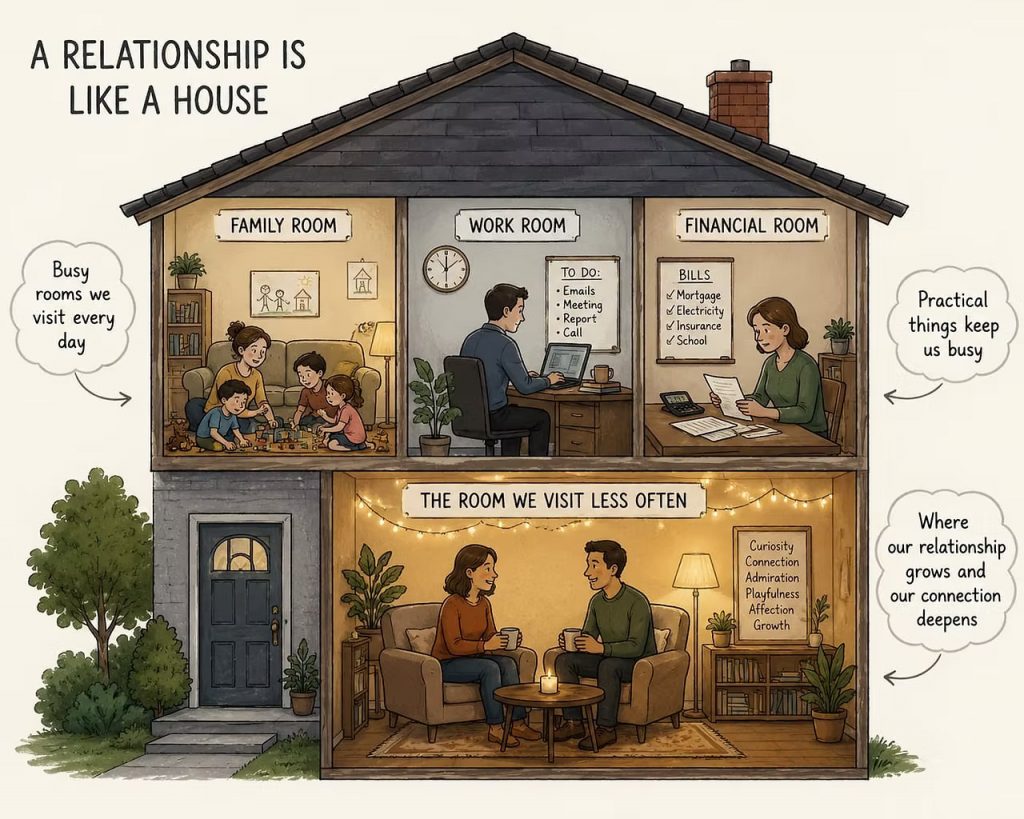
Think of your relationship as a house:
One way of visualising this is to imagine your relationship as a house with a number of different rooms.
Some rooms are extremely busy.
There is the family room, with children, relatives and responsibilities.
There is the work room, with jobs, deadlines and pressures.
There is the financial room, where mortgages, bills, loans and plans for the future are discussed.
There may be rooms for health, household jobs, caring responsibilities and all the other things that come with building a life together.
A couple can spend an enormous amount of time moving between these rooms.
But somewhere in the house there is another room.
This is the room that belongs specifically to the relationship.
It is where there is curiosity about each other. It contains affection, admiration, playfulness, intimacy and conversation. It is where you remember that the person beside you isn’t only your co-parent, housemate, problem-solver or partner in managing the week’s responsibilities.
They are also the person you chose.
For many couples, that room hasn’t disappeared.
They have simply stopped visiting it as often.
Couples therapy doesn’t have to mean something is wrong:
There is a common idea that couples therapy is something people turn to when their relationship is in serious difficulty.
Often it is. But couples therapy can also be useful much earlier.
Two people can love each other, function well as a team and be committed to their relationship while recognising that they would like something more from it.
Therapy provides a space where the normal business of life is temporarily left outside the door.
For that hour, there isn’t a school run to organise, a shopping list to complete or a household job waiting to be done. The relationship itself becomes the focus.
It gives both people an opportunity to think about how they experience the relationship, to become more curious about their partner’s experience and to understand how each person’s history can influence what happens between them today.
The aim is that couples therapy helps you understand yourself and your partner more deeply, and gives you new, compassionate ways of relating to each other. So returning to your own relationship room becomes something you both want to do.
Bringing up the idea of couples therapy:
Sometimes one person begins thinking about couples therapy before the other.
The challenge can be how to raise the idea without it sounding like an announcement that something is wrong. Rather than beginning with a problem, it can help to talk about what you already value in the relationship and what you would like to have more of.
You might say:
“I think we’re really good at doing life together. I’d love us to have some time to focus on us as a couple too — what we enjoy about each other, what we might want more of, and how we can make a good relationship even better.”
This is the win-win invitation. An invitation to explore together what could make the relationship more enjoyable, connected and fulfilling for both of you.
Making room for the relationship again:
If your relationship works reasonably well but doesn’t feel quite as fulfilling as it once did, that feeling doesn’t have to be ignored simply because there isn’t a crisis.
A good relationship can still deserve attention. Sometimes nothing needs to be rescued.
The busy rooms of the house can continue to be busy. The children still need collecting, work still needs doing and the bills still need paying.
But perhaps there is another room that the two of you could start visiting more often.
Myles Doyle is a practising psychotherapist specialising in couples therapy and works with clients at Misneach in Moate, Co. Westmeath. If you would like to explore whether couples therapy could benefit your relationship, he offers a free 15-minute consultation to help you decide if it feels right for you.